The Wild Horses of Old Sagadahoc
June 24, 2026 - 7pm
Bath Freight Shed
Harald E.L. Prins, PhD: Professor of Anthropology, Kansas State University
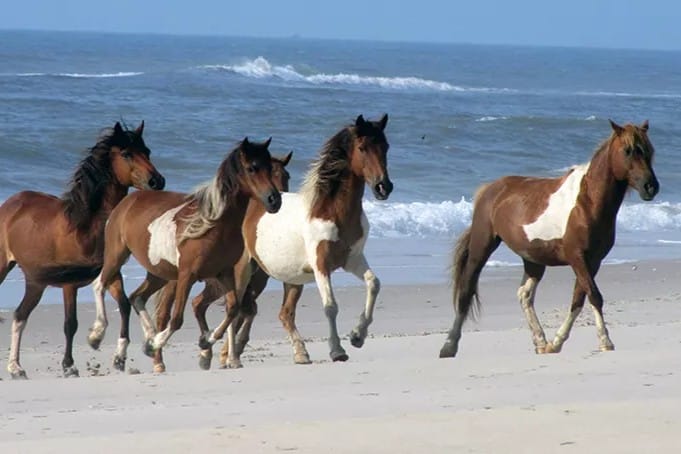
This presentation tells the story of a herd of feral horses that once ranged freely between the lower Kennebec and New Meadows Rivers. They were the descendants of animals abandoned by early European settlers during the Anglo-Wabanaki Wars of the seventeenth and eighteenth centuries, when colonists fled their farms for the safety of Maine’s outer islands.
Wabanaki families continued to frequent their ancestral lands in the Kennebec Valley long after English colonial militia destroyed their last major village at Norridgewock in 1724, massacring its Indigenous inhabitants. At times, and out of necessity, Wabanaki hunters took these horses for survival.
When white settlers later reoccupied this coastal region, the horses were periodically rounded up. Selected animals, most often young stallions, were corralled on the peninsula near the remnants of the short-lived Popham Colony. These horses were then sold and shipped aboard lumber schooners and other vessels bound for the Caribbean and Dutch Guiana (Suriname), where they were sold for the brutal work of tropical plantations and sugar mills, alongside enslaved Africans.
This is the fourth lecture of eight in the 2026 Summer Lecture Series. The lectures will be held on Wednesday evenings at the Bath Freight Shed (27 Commercial St, Bath Maine). The recording will be available below and on YouTube shortly after the lecture.
The lectures are free, but if you consider them valuable, please donate to Maine’s First Ship in person or online.

With generations of Friesian seafarers in his ancestry, Harald E.L. Prins is a Dutch anthropologist and historian. Trained in archeology in the Bronze Age, Middle East, and Mesolithic Friesland, he crossed the Atlantic on a Dutch freighter, worked with gauchos in Argentina, and began teaching comparative history at Radboud University. After film school in New York City, he became a tribal research director for the Mi’kmaq Nation before teaching anthropology at Bowdoin, Colby, and Kansas State University, where he was named University Distinguished Professor. An award-winning author and filmmaker, he has been a Research Associate at the Smithsonian Institution, a Visiting Professor at Lund University (Sweden), a guest lecturer at the École des hautes études (Paris), and an expert witness before the U.S. Senate and in U.S. and Canadian courts.