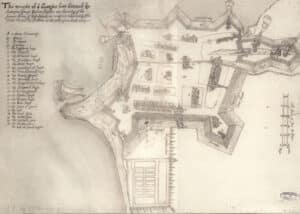
Hunt plan of Fort St George
Hunt Plan – Spain, Simancas General Archive, MPD,19,163 John Hunt The draught of St. Georges fort Erected by Captayne George Poham, Esquire, on the entry
Hunt Plan – Spain, Simancas General Archive, MPD,19,163 John Hunt The draught of St. Georges fort Erected by Captayne George Poham, Esquire, on the entry

Fred Gosbee Ram’s head Rams’s head in use on Virginia To hoist the heaviest spars, ships of Virginia’s period used a large block and tackle

Traditional Rigging Co Like all sails of the period, the edges of Virginia’s sails are reinforced with a rope called a bolt rope which is

Maine’s First Ship Rigging Crew Every block (called a pulley on land) aboard Virginia requires a specially made rope “strop” which will be tied around

Maine’s First Ship Rigging Crew A sword mat is a woven mat that uses thin rope for the warp and twine, or “marlin” for the

Jim Nelson The mainstay mouse is built up of canvas strips called “parceling” wrapped around the heavy rope, and then covered over with a type

Fred Gosbee and Julia Lane

Boats were and still are part of the equipment carried aboard every ship as a tender. The shallop Jane Stevens is Virginia’s boat. A shallop

Sam Manning This drawing depicts Virginia moored near Fort St George surrounded by native canoes. Virginia has ocean rigging but with the sprit main commonly

Gill Ross This depicts Virginia leaving a Maine cove in October 1608 and heading into the Atlantic for her voyage to England. Virginia is in